

Events This Week

The Swedish House Mafia are in town. For Why Beautiful Cities Matter, DI Visiting Fellow Markus Johansson-Martis is joined in conversation by Eric Norin, the founder of a viral Instagram account on architectural revival, and inventor of the Sverigehuset - a new generation of typically Swedish houses. Throw in Gergely Böszörményi-Nagy - father of the Brain Bar - and this promises to be an IQ-maxxing evening full of mortar-Chads and Scruton-Stacies event-mogging the MKI. Tuesday, 5:30PM at the Villa.
In 2006, Germany's Benedikt Böhm set the speed record in 'high altitude mountaineering with downhill skiing' at the Gasherbrum II. He's climbed some of the world’s most dangerous mountains through what he calls 'speed-optimised decision-making'.

In Böhm’s philosophy, performance is not about the romance of endurance, but the ruthless risk management: the longer you remain under pressure, the worse your decisions become. On Wednesday, he's bringing his unique angle on the psychology of decision-making to the MCC (7PM).
Later at the MCC, Ambassador Mitch Fifield, former Permanent Representative of Australia to the United Nations, is talking Trump 2.0.

February 20, 3:00 PM - 5:30 PM
Around Town
Perspectives and people from the week
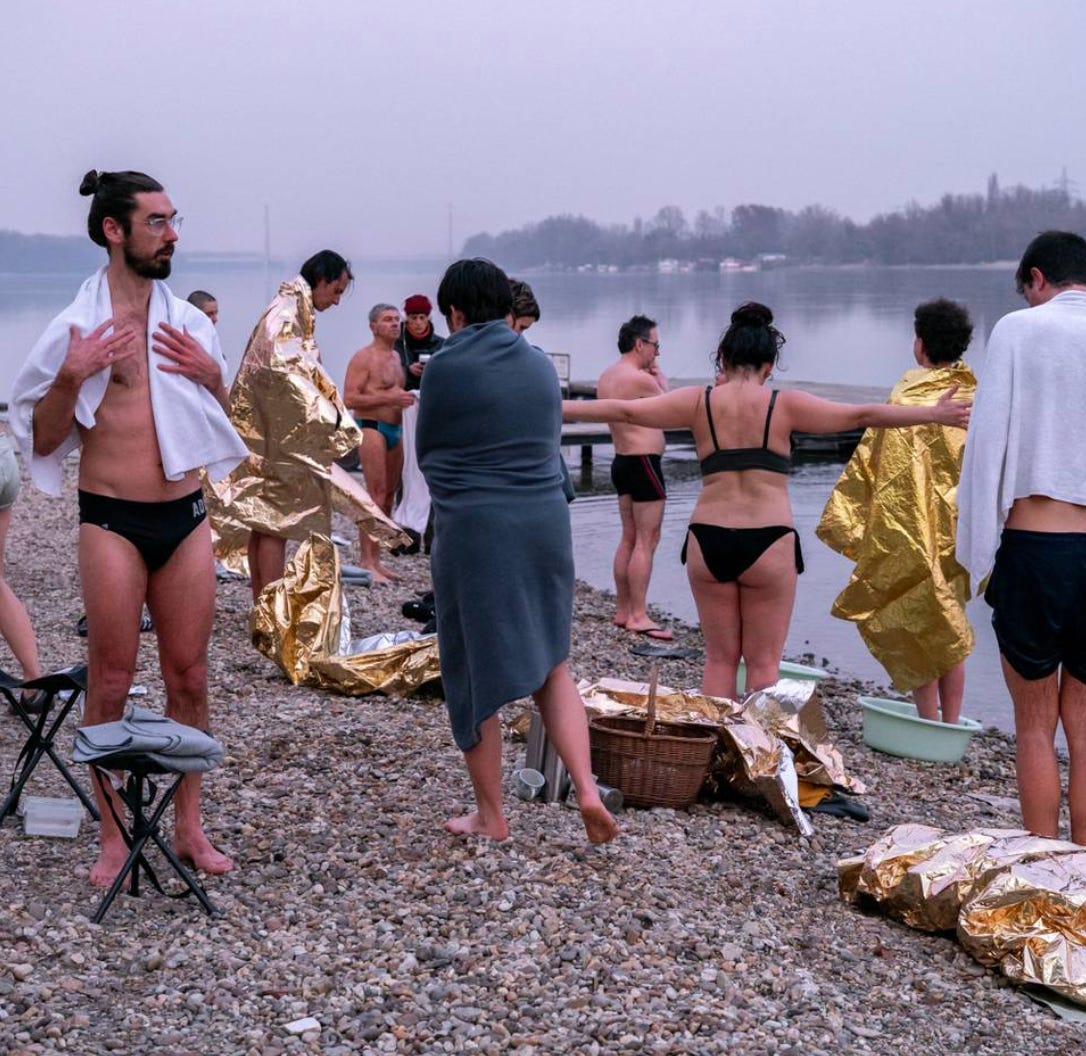
If you see a squadron of red-hot half-naked people plunging into the river this week, that will be the BLACCC. 18-22 Feb, they're operating a mobile sauna on the lower banks of Buda, down towards Dürer Kert. It fits 20, and tickets are 4000 Ft for 90 minutes. An icy dip in the Duna is also recommended. Every day at 18:30, there is also a talk on sauna culture - but given that one will be on 'hydro-feminism', perhaps tackling the frozen river is preferable.
Pierre-Hugues Barré is our newest fellow. This week, he got into the muck of the recent court cases involving Marine Le Pen - convicted under a procedural law that bars politicians from diverting their EU Parliament researchers into French party-political work.

Return to your roots: the 14th Africa Expo Budapest opens 19 Feb, until the 22nd at HUNGEXPO. Twenty exhibitors representing twenty African countries. There'll be masks, sculptures, art, clothes, drums, dance, music, kids stuff.

Based In Budapest arrived at Budapest Global Dialogues early last Tuesday, but a little late for Péter Szijjártó's opening speech. Whereupon an elderly gent came up to us in the lobby. "Beautiful ladies in this town," was his opening gambit.

This, it later transpired, was Edward Luttwak, 83, honoured speaker, former advisor to Shinzo Abe, and author of Coup d'Etat: A Practical Handbook (later made into a film, in which Luttwak himself was played by Peter O'Toole).

 And, after telling us about how he'd advised South Africa's Apartheid government to evacuate Pretoria in order to create a defensible ethno-state in the Cape, sucked into his personality vortex, thirty minutes later, we'd begun a mad dash across town to find a kilo of high quality Rubin paprika he could ship back to America. Over the course of three cab rides, he unfurled a life story that was somewhere between John Le Carré, Philip Roth and Woody Allen's Zelig.

At one point, he mentioned that he'd been at LSE in 1961.

"Ah, Mick Jagger would have been there about then, no?"

"Jagger?" he replied. "He was in my econometrics class. He was the top student. When he told the teacher he was dropping out to pursue his band, they said he was crazy! They said he had the chance to be one of Britain's top economists. Why would he give it up for doof-doof-doof!

"I still go out to St Barts to see him. One year, we played a game, where we tried to guess the nationalities of people walking from the harbour up to the beach. Really smart guy."

The only lesson here is: always be late to conferences - you never know who you'll meet.

Paper of the Week
Small States, Heavy Pressure: Hungary and Slovakia in the Crosshairs of Liberal Power
In which Michael O'Shea is on the case of the Brussels influence machine.

As he points out, in recent years, the EU has channelled whopping sums to pro-EU organisations. Its Citizens, Equalities, Rights and Values scheme has a budget of €1.5 billion.

To pick one case, the pro-EU Brussels think tank the Centre for European Policy Studies (CEPS) received €250 million – one quarter of a billion – just over the past 10 years.

More troubling still, it has funnelled money to anti-government orgs within its most troublesome members states, Slovakia and Hungary – €38
million and €41 million respectively, just through the CERV.

'Is this democracy?' O'Shea wonders.
MEMO 98 and CHCEM TU ZOSTAŤ were not the only nonprofit groups engaged in leading pre-election activities in 2023 [in Slovakia]. For example, the organization Mladí proti fašizmu ([the EU-funded] Youth against Fascism) funded and organized trips for
students living in Czechia to return to Slovakia to vote in the parliamentary elections.

While such activities met a technical definition of nonpartisan behaviour, they targeted at least two demonstrably left-leaning voting blocs (young voters and expatriates). Expatriates voted in record numbers in that election, and more than half of them voted for the left-wing Progresívne Slovensko (Progressive Slovakia – PS) party.
Comings & Goings
Going:
Alex Lefebvre
We have thoroughly enjoyed the presence of the liberal political philosopher Alex Lefebvre in the department over the past month. He has been squeezed hard for content, but his final work was possibly his greatest - an hour on Danube Politics, unpacking what he learned from studying The Hungarian Model.

His vision for repairing liberalism at an electoral level? "Basically something like non-predatory Bill Clinton - and I can't emphasise enough, no sexual predation..."
Dates For Your Diary
CPAC Hungary — 21 MarchNatCon Brussels — April"Azt hiszi, ő szarta a spanyol viaszt." — He thinks he shat the Spanish sealing wax. (Someone thinks he invented something novel that was, in fact, perfectly obvious)