

Events This Week

As we all know, Climate Change was invented in 1990 to terrify tweens. It failed in that regard, yet here we are: voluntarily clanging our way back to the Fred Flintstone Age, while China burns to victory on the coal of a thousand suns.
Climate Change is wedged so deep into our world view it may be politically irreversible — whatever the true impact of a 1.5C rise in temperatures by 2100.
But in truth we shouldn’t be thinking about Climate Change at all, says Calum Nicholson. Rather, we should be thinking about human adaptability to environmental change — how can we work round it, socially, agriculturally, economically?
Dr Nicholson, a local anthropologist, used to work on these matters at Cambridge, then at MCC. He is now presenting a live version of his paper: How To Think About Climate Change Beyond The Culture Wars — with no safety net.
Come to the Villa on Tuesday for a juicy evening of what our haters would no doubt call Climate Denialism — we like to call it Climate Positivism.
5:30PM
Register here:
https://danubeinstitute.hu/en/events/how-to-think-about-climate-change
Trump did the easy bit first: smashing USAID to smithereens.
Now comes the hard bit: building a system of relations with Africa that can compete with the Chinese Belt & Road initiative.
But so far, Trump Part II’s chief contribution to the upside seems to have been to let off a few rockets in Nigeria.
Perhaps Tibor Nagy can explain? Despite his name, Nagy is an American — the Former US Assistant Secretary of State for African Affairs. He’ll be talking to Viktor Marsai, from the Migration Research Institute, 5PM, Tuesday, MCC.
https://mcc.hu/en/event/2026-06-16-from-the-m23-to-the-usaid-cut-the-us-africa-policy-in-a-transactional-world
Have you heard of AI? It’s like computers, only more so, but they also need a lot of water for some reason.
Anyway, everybody’s talking about it. And you can too — at the MCC Scruton on Friday, where the MKI-MCC Center For Geopolitics team are joined by two figures who really do know what they’re on about.
Mehran Gul — author of The New Geography of Innovation.
And Arvind Gupta — head of Digital India.
That’s: Competitiveness in AI and Digitalisation.
5PM. Tas Vezér utca.
https://mcc.hu/en/event/2026-06-19-competitiveness-in-digitalization-and-ai
Around Town
Attila the Hun gets a lot of bad press these days. Apparently he had ‘hordes’ and they ‘rampaged’, and none of that is appropriate behaviour for a grown man.
The Hungarians see him rather differently — clue’s in the name. Now, a major new exhibition at the National Museum promises to fill in the gap between Attila the rampaging warrior, and Attila the rampaging warrior but that’s good actually. It contains over 400 artefacts from the Hun era, prospected from the world’s top museums — the Louvre, the British Museum. In addition to recreated yurts, the show includes long-skulls — the Hun were head-shapers, they practiced ‘ritual cranial deformation’.
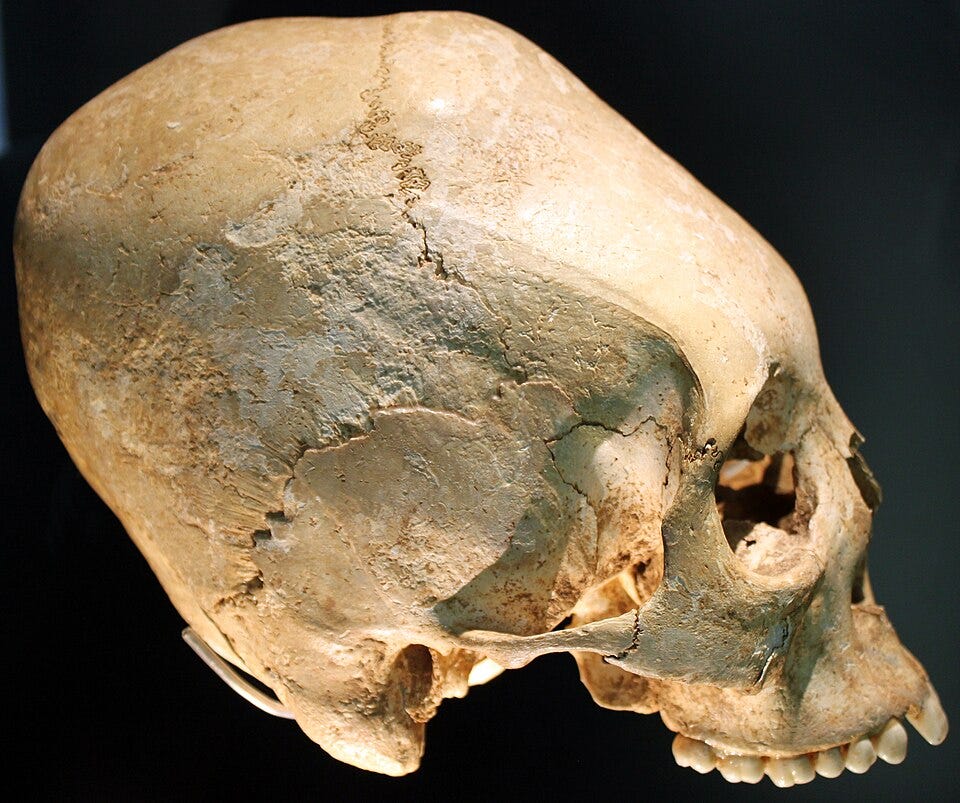
Runs till 23 July. Sign up here:
https://jegy.mnm.hu/programok/reszlet/attila-_1768552366

The Beatles are widely known for their classic hits including Last Train To Clarksville, Daydream Believer and (Hey Hey!) We’re The Beatles.
Celebrate them, with a short festival at Kobuci Kert, Fő tér: Sunday, 4PM till late.

Byrne baby Byrne: the Talking Heads autist is back in town after a 17 year absence.
Thursday, Papp László Budapest Sportaréna.
Not to be confused with The Seventh Seal, The Fifth Seal is a classic Hungarian war movie, set in Budapest in the time of the Arrow Cross.
It’s not only one of the masterpieces of Hungarian cinema — but also one of the best movies of 1976, maybe of the ‘70s, possibly even the entire 20th century.
Whereas the sealed scroll that Bergman’s Seventh Seal is named after is the one whose opening is said to herald ‘the seven angelic trumpeters’, the fifth seal is the one whose opening reveals ‘the martyrs’ prayers, beseeching God’s vengeance’. Yup, it’s a Hungarian film.
Thursday, it’s playing at Bem Mozi, 6:30PM
By now we all know the Art of the Deal method — Trump comes in hard, rolls you with a fantasy number, twists your expectations, then meets you at his new ‘halfway’, singing your praises. But have the Chinese read this important work — the Western equivalent of Sun Tzu?
That’s the question the DI’s Sean Nottoli is pondering in a new blog on the LSE’s China Dialogues sub-site.
Raymond Ibrahim is in DC this month. He spoke at a Coptic convention (Ray is a Copt himself). And he appeared on a podcast with his old mentor, Victor Davis Hanson — in which he shouted out his work with the Danube Institute. Not a lot of people know that Ray was once VDH’s pupil, and Vic was his thesis advisor.
Here’s the proof: the pair of them chilling at a barbecue on VDH’s almond farm — 1998 or ‘99.

Simon Cottee continues his extensive PR tour around his blockbuster paper on Jihadis and what they get up to: he’s been hacking through the junkets like Sydney Sweeney. Not content with a drop-in appearance at the seminar discussing his paper, he has also done an hour on Danube Politics, telling the show that ‘your average Jihadi now is something of a loser…’, and reflecting on the ideological capture of his home discipline, criminology: “Very few criminologists are interested in doing qualitative analysis on the roots of radicalisation… they just don’t want to touch it.” Tune in to hear about the Fourth Wave of Jihad.
France is the enemy of the family: so says Pierre Hugues-Barré.
Calum Nicholson, a local anthropologist, has spent many an hour amusing BiB with his shrewd insights about Hungary. Calum is a setlist kind of guy. He alights on an idea, then works and reworks his material endlessly in casual conversation, hardening the original hazy notion into a series of diamond-hard bits, as a comedian might. In Brussels last month, at the Liszt Institute, he used the Exciting Time of Change as the excuse to let rip a dozen or more of his all-time best insights into How Hungarians Work. This is the biggest greatest hits set of the think tank year. It’s Queen at Wembley, folks. Enjoy.
Paper of The Week
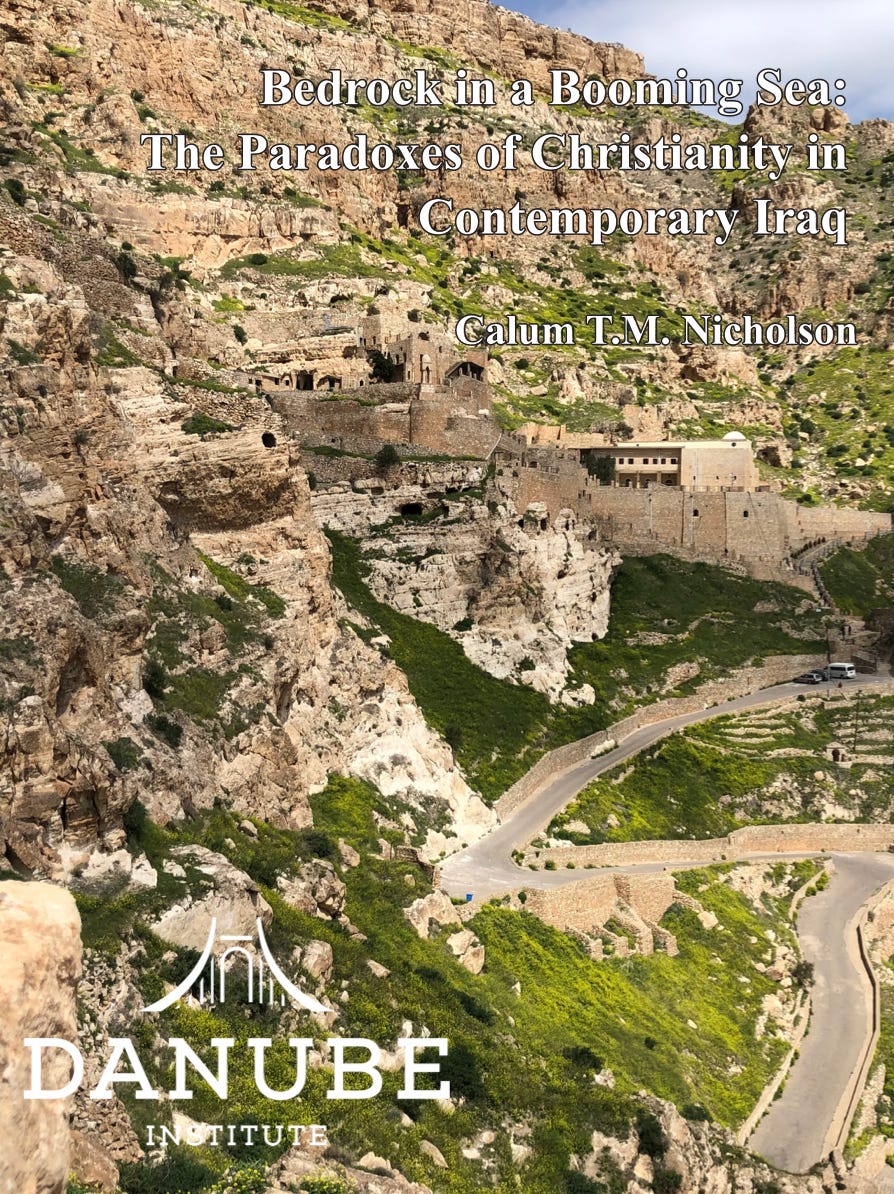
Calum Nicholson, memoirist and vaguely piratical anthropologist, went to Iraq to conduct fieldwork on the plight of Christians in the region. What he came back with was something more nuanced than a simple tale of persecution.
His latest paper, a compendium of top-and-tailed field notes, has the air of Graham Greene, or Shooting An Elephant. A tale told through multiple cultural lenses, with much gamesmanship on both sides, that serves to reveal some central truths about human nature.
The edges of Iraq are peopled by several non-Muslim or dissident-Muslim sects. From Catholics to Yezidis. The Yezidis are best known for what ISIS did to them. Less known is that they are not heretical Muslims, nor Christians: they worship a ‘peacock angel’.
In this strange hinterland of faith, the peacock angel devotees shared the road with devout Sunnis, Shias, and the more Westernised followers of Rome, and we witness an encounter not just between multiple faiths — but between ancient tribalism and modern individualism.
After ten days of meetings that often felt more like political audiences than they did sociological interviews—a feeling not helped by the constant presence of our “translator” and guide, a former Kurdish soldier with a furtive manner and a free associative approach to translation, and who seemed tasked more with watching than assisting us—I felt we had exhausted the genre. The meetings had taken on a pattern, and it was clear that there was little real insight to be gained from talking with this class of interviewees, them being polished politicians to a man, their quick eyes a counterpoint to the stiffness of their cassocks and the steepled stillness of their hands. There was also an additional problem, an unintended consequence of having a schedule of interviews planned long in advance.
One day, for instance, we drove out to the relatively remote Nahla valley, an ancient Christian community to the north of Duhok. On arrival at the local church, we quickly realised we would not be able to conduct many interviews, as we were received not as powerless researchers, but as foreign dignitaries. The community’s leaders had all gathered for a semi-ritualised reception, which etiquette dictated we submit to.
“Kering mint gólyafos a levegőben.”
— It’s floating in the air like a stork’s droppings. (He has no idea what he’s doing; he’s wandering around aimlessly)